top of page

The Archosaur Asylum Vol. 29: Paleoart: Reconstructing Prehistoric Life

"Acro-Pack:" Attack-1:57 Scale Acrocanthosaurs

Paleoart sits at the intersection of science and interpretation. It’s the process of rebuilding prehistoric life through visual and physical media—taking fossil evidence and turning it into something we can actually see and understand.

No one has ever observed a non-avian dinosaur in life. Everything we know comes from fragments like bones, impressions, trace fossils, and the work of piecing those fragments together. Paleoart exists in that space between what is known and what can be reasonably inferred.

At Ancient Era Artistry, that balance is the focus: creating work that feels alive, while staying grounded in the evidence.

What Is Paleoart?

Paleoart is the reconstruction of extinct animals and ecosystems using scientific evidence. It’s used in museums, research, and private collections to make prehistoric life visible.

This involves:
- Interpreting fossil material  
- Comparing anatomy with living animals  
- Understanding movement and function  
- Placing organisms in a believable environment  

There isn’t a single final answer. Each reconstruction is a snapshot of current understanding—something that can shift as new discoveries are made.

Building a Reconstruction

Everything starts with structure. Fossils give us the framework, but they’re never complete. From there, reconstruction builds outward, adding muscle, mass, and presence based on how living animals work.

Modern species are essential here. Birds, reptiles, and mammals help fill in the gaps, offering real-world constraints on how an extinct animal might have moved or behaved.

The goal is to stay grounded. Not rigid, but not speculative for the sake of it either. When done right, the result feels believable because it follows the same rules as life today.

Accuracy and Interpretation

Being scientifically accurate doesn’t mean having every detail locked in. Some features are well supported by fossil evidence. Others—like coloration or display—are often unknown.

That’s where informed interpretation comes in. Paleoartists look to patterns in modern animals to guide those decisions, keeping things plausible without overreaching.

Because of this, paleoart works best as a visual hypothesis. It shows what an organism could have looked like based on the best available evidence at the time.

When the Science Changes
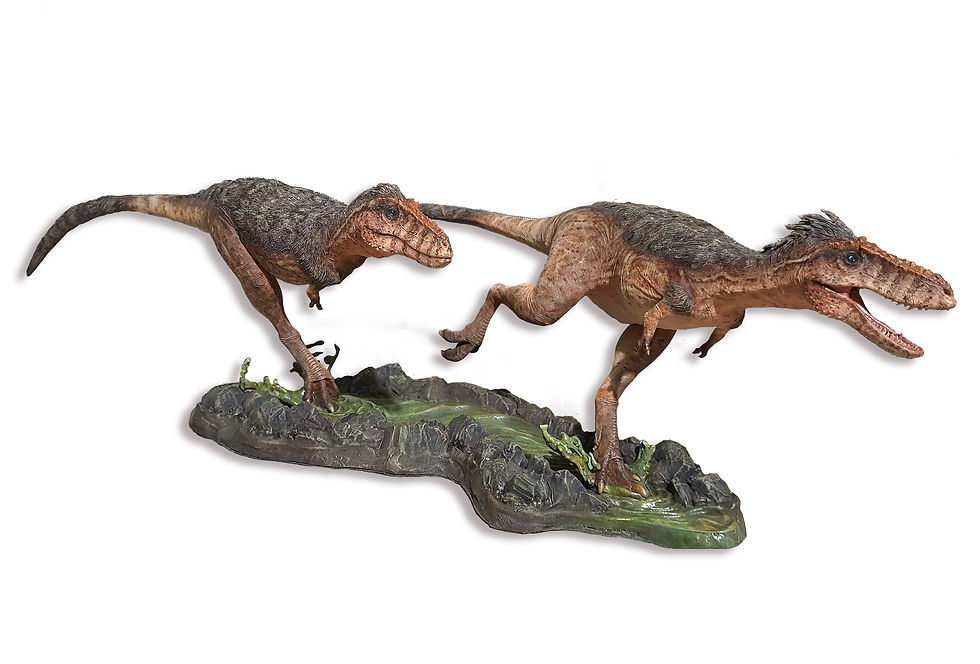
"Twinning:" Juvenile Tyrannosaurus rex twins... Or Nanotyrannus?

One of the most important things to understand about paleoart is that it evolves.

A good example is the ongoing debate around Nanotyrannus. For a long time, many researchers considered those specimens to be juvenile Tyrannosaurus rex. That idea shaped how they were reconstructed across the field.

More recent work has challenged that interpretation, reopening the possibility that Nanotyrannus is its own distinct animal. The discussion is still active, but the shift has already influenced how these specimens are viewed.

That has a direct impact on existing work. The “Twinning” model from Ancient Era Artistry—two running juvenile T. rex—was built around what was understood at the time. With newer interpretations, those same animals could just as easily be seen as Nanotyrannus.

That doesn’t make the piece wrong. It places it in context.

"Between Meals:" Another depiction of the dubious juvenile T-Rex.

Is It Okay for Paleoart to Become Outdated?

Yes—and it should be.

Older pieces reflect what was once considered scientifically accurate. As new discoveries come in, those works become part of the story of how our understanding has changed.

Displaying older and newer interpretations together adds depth:
- You see how ideas have evolved  
- You see where assumptions shifted  
- You see how evidence reshapes reconstruction  

A piece like the “Twinning” model can be shown as originally intended, or reinterpreted through newer research. Either way, it holds value.

Outdated paleoart isn’t a problem—it’s a record. And in many cases, it makes for a better conversation piece than something static and final.

"Scent in the Air:" 1:35 scale-  T.rex... A less robust T. rex, reflecting the science at the time.


Paleoart Across Mediums

Paleoart isn’t tied to a single format. Whether physical or digital, the same principles apply:
- Start with fossil evidence  
- Build a solid anatomical foundation  
- Use living animals as reference  
- Keep the environment believable  
- Stay open to change  
The medium changes, but the thinking behind it doesn’t.

Why Paleoart Matters

For most people, paleoart defines what prehistoric life looks like. It turns abstract data into something immediate.

That comes with influence. A single reconstruction can shape how an animal is imagined for years. But it also creates an entry point, something that draws people in and makes them want to learn more.

Done well, paleoart connects science to experience.

A Living Record

Paleoart isn’t about getting the final answer—it’s about getting closer.

Every piece reflects what was understood at the time it was made. As that understanding changes, the work doesn’t lose relevance. It gains another layer of meaning.

That’s especially true in a collection. Older and newer pieces together tell a bigger story—not just about the animals, but about how we’ve come to understand them.

At Ancient Era Artistry, that idea carries through the work: building reconstructions that hold up to current thinking, while still being part of a much longer, evolving process.


Scientifically Accurate Acrocanthosaurs Model Kit – 1:57 Scale 32mm Model
From$35.50
Buy Now
Scientifically Accurate Acrocanthosaurus Model Kit – 1:35 Scale Collector Model
From$48.00
Buy Now
Scientifically Accurate Paralititan Model Kit – 1:35 Scale Collector Model
From$298.95
Buy Now


Paleoart FAQ:

What is paleoart?  
Paleoart is the reconstruction of prehistoric life using fossil evidence, anatomy, and comparisons with modern animals. It is used to visualize extinct species in a way that is both engaging and grounded in science.

How accurate is paleoart?  
Paleoart aims to be scientifically accurate, but it is always based on incomplete evidence. Some features, like skeletal structure, are well supported, while others—such as coloration or display—are informed by modern animal analogs.

How do paleoartists know what dinosaurs looked like?
Paleoartists start with fossilized bones and any preserved soft tissue, then use modern animals as references to fill in missing details. The goal is to create a scientifically accurate representation based on available evidence, while acknowledging areas that remain uncertain.

Is paleoart always scientifically accurate?
Paleoart aims to be scientifically accurate, but it is always based on current knowledge. As new discoveries are made, reconstructions can change. What is considered accurate today may be revised in the future.

What makes paleoart scientifically accurate?  
Scientifically accurate paleoart is based on fossil evidence, functional anatomy, and comparisons with living animals. It avoids unsupported speculation while remaining open to interpretation where evidence is limited.

Can paleoart be wrong?  
Yes—but “wrong” is often just outdated. Paleoart reflects the best available knowledge at the time it was created. As new discoveries are made, interpretations change.

Does that mean older paleoart is wrong?
Not necessarily. Older paleoart reflects what was considered scientifically accurate at the time it was created. As new evidence emerges, these works become part of the historical record of scientific understanding rather than mistakes.

Why do some dinosaur models change over time?
Changes in fossil discoveries, technology, and scientific interpretation all influence how dinosaurs are reconstructed. As new information becomes available, models and artwork are updated to reflect a more accurate understanding.

Is Nanotyrannus a real species or a juvenile T. rex?  
This is still debated. For years, many scientists believed Nanotyrannus specimens were juvenile Tyrannosaurus rex. More recent research has challenged that view, suggesting it may be a distinct genus.
Paleoart has shifted alongside this debate.

Why do some dinosaur models become outdated?  
New fossil discoveries and improved research methods can change how species are understood. When that happens, older reconstructions may no longer reflect current thinking—but they still represent an important stage in scientific understanding.

Is outdated paleoart still valuable?  
Absolutely. Older pieces show how scientific ideas have evolved over time. When displayed alongside updated reconstructions, they add context and often become strong conversation pieces.

Does paleoart only include drawings or paintings?  
No. Paleoart includes all forms of reconstruction, including physical models, sculptures, and digital work. The medium can vary, but the goal remains the same: to represent prehistoric life as accurately as possible.

Can I still display outdated paleoart?
Yes. Outdated paleoart can be displayed as a representation of past scientific thinking or reinterpreted using modern knowledge. Many collectors value older pieces because they show how our understanding of prehistoric life has evolved.

Why is paleoart important?  
Paleoart helps bridge the gap between scientific research and public understanding. It turns fossil data into something visual and immediate, making prehistoric life easier to study and appreciate.

What makes a paleoart piece valuable?
Value comes from a combination of scientific grounding, craftsmanship, and context. Pieces that reflect a specific moment in scientific understanding—especially when paired with updated interpretations—often become more meaningful over time.

Comments

Rated 0 out of 5 stars.
No ratings yet

Add a rating

Subscribe to newsletter  

Thanks for subscribing!

HAND MADE USA BADGE.png
KLARNA.jpg
Affirm_Logo.jpg

407-782-3329 

Matt@think-loudly.com

Ancient Era Artistry produces scientifically accurate, ultra-high-detail dinosaur and prehistoric model kits for collectors and museums.
These kits ship unbuilt and unpainted-
Unless a painted model is chosen, arrangements are made FOR PAINT, paint 0R Model kit built options ARE CHOSEN.
*aNY KIT MAY SHIP WITH PRIMER AT THE DISCRETION OF aea.


Each kit is made to order.  Please allow 2-8 weeks for delivery on non-pre-order items.
Potentially. Longer delivery times for painted orders. 

Check specific item delivery estimations for pre-orders. 

DIgital files are protected by the

thinkloudly creative private use license 

©2022 by ThinkLoudly Creative LLC. 

** Models may arrive primed in any color regardless of selection made during purchase **

bottom of page